
- Mental Health
By Wendy Lee Nentwig
Perfection and pain are often intertwined. When Jacki Munzel was still in her teens, she was on track to achieve her goal of Olympic greatness. Ranked fourth in the U.S. in figure skating, Jacki was singularly focused, determined to achieve perfection in her sport. That desire led her to a very dark, painful place, though. Eventually her dreams were dashed by a serious eating disorder, but what seemed like an ending was only the beginning of her story.
While she doesn’t blame skating for her eating disorder, Jacki does see how being an elite athlete contributed to her food issues. The constant pressure to stay skinny plus a family history of addiction added up to a full-blown eating disorder. While she saw others choose alcohol or drugs as an escape, Jacki didn’t like the lack of control that accompanied those habits. Bingeing and purging let her maintain a façade of control. As a result, her drug of choice became food. Rather than using it as athletic fuel, it became both a punishment and a reward.
When looking back at that painful time, Jacki recalls using her disorder to punish herself for not feeling like she was living up to expectations or her potential. As she progressed in her skating career, she was never able to admit how scared she was. The pressure to perform was intense and there was no room for fear.
In addition to the pressure of her sport, Jacki was also dealing with a lot of family dysfunction as well as sexual, physical and emotional abuse. Her eating disorder became her way of coping with the shame she felt about that abuse. While she struggled to hide her eating disorder, Jacki also used it as her way of acting out.
Jacki knew her eating wasn’t normal. She knew she had a problem, but she wrongly believed she had control over it. She finally had to admit she wasn’t in control when driving with her sister after having taken 60 laxatives. Her body began to seize and she lost control of her bodily functions. Her frightened sister had to put her foot on the break and push the car off to the side of road. It was the initial wake up call Jacki needed. At that moment, she realized she was an addict and that if she continued skating, she was going to kill herself.
Despite that realization, she felt she had no place to turn, and full recovery was still a ways away.
“I still wasn’t being truthful,” she recalls. “I quit skating and stopped the laxatives, but I kept throwing up.”
She tried getting better on her own terms, and she made some positive changes, but her disease was still her dirty little secret. It was only during her first marriage when she went to counseling that she finally started talking to a professional about her eating disorder. The story began trickling out at last, and it felt good to start being honest.
While pregnant with her second child, Jacki’s doctor discovered a heart murmur. It was the final push she needed. “I wasn’t going to hurt my child, so I got sober,” she says. The process took 16 years and included two relapses, but she was finally headed in the right direction.
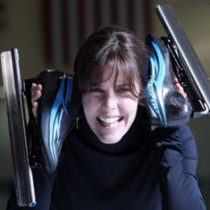
Today, so much has changed. While there’s always more work to do, Jacki is doing better than ever. She now has a healthy relationship with the scale, using it to be sure her body has what it needs—especially all the nutrients and energy for her training. She has returned to the ice, this time choosing speed skating. She’s been skating competitively for two years and teaches power skating to others. Jacki does not have access to a regulation oval for her own training ventures, but she trains on Plexiglass in her house. She also rollerblades, runs, and does short track exercises. In March 2012, Jacki competed in speed skating to place first in her division (ages 40-49) in the 21st Masters International Allround Games in Germany, and first overall in two races (30 and over). She is now ranked ninth in the nation for speed skating. She’s hoping to qualify for the Olympic trials in 2014 (as of April 2012 she is fifteen seconds away from qualifying time), and while an Olympic medal may be a long-shot, Jacki is just amazed to discover how responsive her body can be when it’s treated right.
For others who have yet to take that first step, Jacki encourages them to start by admitting they have a problem and seeking help. For years, she continued to cover up aspects of her disorder. It wasn’t until she was completely honest that she felt free. For her – and for many others – it takes time.
“Your truth right now is all that you can tell,” she says, “and that truth is amazing, and it’s okay that you’re not able to say it all at once.” Don’t beat yourself up. Instead, Jacki recommends celebrating the small victories and being kind to yourself.
“I have been given a second chance at life, and because I worked the program and saw that the end was not tomorrow, but further down the line, it gave me the freedom to be okay with my body,” Jacki says. “It’s a humbling, exhilarating feeling.”