
- Alcohol
- Drugs
- Mental Health
Submitted by: Susanne Johnson
Illusions of grandeur, a dash of fear, and a persistent Napoleonic complex are what this little boy was made of; right from the start I was different. I felt more, I worried more, and I strived obsessively to be liked. I constantly daydreamed about being an athlete, a leader, or a politician. In any situation, I sought to be in the limelight. I never passed up the opportunity to jump in a photo or glimpse in a mirror. As far back as I can remember, I was a sensitive youngster who internally felt other people’s pain. I hated bullies and at times I risked certain death by sticking up for the underdog in a fight.
I spent the first 17 years of my life in my hometown of Deshler, Ohio. Deshler was a close-knit, predominately farming community and most of the folks were of German descent. This partially explains why most events, from church socials to polka dances, featured a frothy golden intoxicating brew, aka beer. Every occasion, or lack of occasion, was an excuse for a cold one. Although, the census of Deshler was around 1800 people, the population supported six full service bars. We also had an overabundance of Christian churches to balance out the amount of drinking that took place in the community.
I attended kindergarten through senior high school in the same building. I was blessed with three sisters and a traditional Midwest upbringing. My parents were extremely hard-working people and outside of work, the focus was on family and extended family.
I started sipping beer at a very young age while sitting on my dad’s lap. I still remember sprinkling salt on the foam to minimize the bitter taste. I know now that salt and alcohol both release the brain chemical dopamine, the neurotransmitter responsible for delivering pleasure.
As I grew into my teens, I was never denied beer as long as I drank it at home. This practice lasted until I was 15 when I started riding in cars with boys. In small-town USA, minors buying alcohol was barely a challenge. With a case of beer in tow, we would roam the back streets and vast cornfields that surrounded the town. Obviously, huge amounts of beer, fast cars and bored teenagers brought angst to the community; nevertheless many of the folks in Deshler viewed this behavior as a right of passage.
By the time I was 16, I was drinking every weekend. Looking back, I never actually liked the taste of alcohol, but I really loved the effect. Alcohol numbed my fears and quieted the voices that told me I didn’t measure up. Deep-seated feelings of unworthiness hounded me through my early years and seemed to get worse as I became older and more successful.
In 1968, at the ripe old age of 17, I enlisted in the Air National Guard. I was so naïve about what I was actually doing that when I took the enlistment oath, I swore into the “International Guard,” not the Air National Guard. My swearing-in officer and new boss, Captain Jim K., laughed out loud at my ignorance. I didn’t even know the name of the military service to which I had just made a six-year commitment.
In the military, my drinking escalated. It was condoned and often used to promote morale. My morale always needed a boost, so I was a regular at the combined NCO & Officers Club on the base. In spite of working full-time, being in the Air Guard, and attending night school, I still found time to drink. I was prudent about finances, except for the high cost of drinking and drag racing. I saved money out of every check and made two large capital purchases– one, a new bright orange 1969 Plymouth Roadrunner, and two, a mobile home.
In one of my early psychology classes, I learned about Maslow’s Hierarchy of Needs. I studied it objectively, and then declared that I had reached the pinnacle of the theory known as Self-Actualization. Yes, at the age of 21, I had advanced to the highest levels of mental, intellectual, and emotional maturity. Rarely had such a feat been met at such a young age, and I most certainly could not have arrived at this level without the help of booze and pot.
During this time, I stopped going to Mass and only prayed when I deemed it absolutely necessary. I was dating my high-school sweetheart, but I had a real problem with fidelity. In fact, I was a serial cheater. Obviously, you attract what you are, and I attracted other narcissist cheaters who possessed the same character defects as myself: grandiosity, dishonesty, and extreme self-centeredness.
The year was 1974, and my Air Guard unit had one pilot training slot allotted for that year. There were six potential pilot candidates, two touting Master’s degrees, three with Bachelor’s degrees, and me– with two years of college. We had all passed the written exams (for me, it took two attempts) and the stringent Air Force pilot physical exam. The six candidates waited with bated breath for Colonel Charlie B. to decide which one of us fine young men would attend pilot training that year.
One evening, while drunk and rolling on the floor of the NCO/Officer Club with my good friend, Jeff Davoll, Colonel Bell approached me. He pulled me up by my hair, and said, “Smitty, anybody that gets as drunk as you will make a damned good fighter pilot– I am sending you.” The vision of pulling that T-38 off the runway just got a lot closer to becoming a reality– but first I had to complete Officer Training School in Knoxville, Tennessee, and Flight Screening School in Hondo, Texas.
Air Force pilot training was a blast. The long hours of studying paid off with the thrill of strapping into a super-sonic jet, and doing things in the air I could have never imagined. Acrobatic maneuvers, fingertip formations, or buzzing just above the treetops at 500 mph were everyday activities. God, I loved the thrill of being in control of these incredible flying machines – it was the best rush ever.
In spite of my dedication to flying, my drinking landed me in trouble several times that year– once, after dumping my motorcycle while running from the Air Police, and another time for pulling strippers off the stage in the Officers’ Club. Either of these offenses today would bring an instant court-martial. Ignoring the threats from my commander, I pressed on partying like a mad man.
Despite drinking problems, bar fights, black eyes, and a lackluster performance in the T-37, on October 18, 1975, I received my coveted Silver Air Force Pilot Wings. This was a real accomplishment that added to my already oversized alcoholic ego.
After being humiliated in survival schools, I attended a seven-month transition course into the F-100 in Tucson, Arizona, to become a fighter pilot. I graduated from the F-100 course with the top academic record in my class, and was second in accuracy on the bombing and strafing of targets.
I had walked away from the military after 12 years not knowing that Braniff Airlines would soon file Chapter 7 bankruptcy. With the airline industry cutting back, and the fact that I have burned my bridges in the Toledo Air Guard, there was little hope of finding another flying job. Needing to feed two babies, I started down the road to a new career in real estate. I completed the classes and testing to become a licensed real estate agent, and later on a licensed broker.
One Sunday afternoon, while answering phones at my real estate office, an Air Force Reserve Colonel from the Selfridge Air Force Reserve Base called and offered me a position flying C-130s. He had found my name on a computer list that showed my clean record, and that I was only eight years short of a military retirement. Although Selfridge was about a two-hour drive north, I jumped at the chance.
With boundless cocaine-induced energy, I pressed on and became the active Real Estate Broker for the largest building company in northwest Ohio. I was managing five partnerships, flying for the Air Force Reserves, and was helping raise two sons. During this time, I was drinking daily and using cocaine a few days a week. Since I was high functioning, I was convinced that it wasn’t hurting me and I could quit at anytime. Besides, getting high took the focus away from my failing marriage.
As if I didn’t have enough on my plate, in 1986, United Airlines hired me. I knew I had to quit cocaine because the airlines were drug testing. Soon after starting with United Air Lines, my marriage ended. Though I took a break from using cocaine, I quickly filled the void with increased alcohol consumption.
I was well connected in the drug world and had access to the best drugs around. My main drug dealer called me ironman because of the large quantities of cocaine I could ingest in a single setting. I would use cocaine to get high and booze to bring me down. I thought I was hiding my behavior from my sons, but I wasn’t.
For me, the real truth about alcohol and drugs is that they robbed me of everything decent in my life. For years, my brain lied to me and told me that I didn’t have a problem. I destroyed every healthy relationship in my life, ultimately costing me the respect of my sons.
I could not look in the mirror without screaming at myself over what a piece of shit I had become. I would slap the side of my face so hard that on several occasions I gave myself black eyes. I hated myself and I had no idea what to do. I believed to my core that I was unique and that AA or rehab would not help. Eventually, I accepted that I was going to die from my addiction.
I continued to fill my body with alcohol and my head with resentments and self-pity. Failed relationships and my lack of self-worth were intensified by my insatiable need to be loved. I longed for good friends, but was incapable of being a friend. The booze had long since stopped working and there was only one thing that could ease my pain– cocaine.
People who suffer from drug addiction follow a progressive road to utter destruction. My addiction to booze, cocaine and obsessive thinking brought me to a despicable bottom, which would undoubtedly end in death.
There is a saying, “God does for us what we can’t do for ourselves.” What happened next changed everything in my life forever– everything I believed in and everything I was attached to.
The evening of February 3, 1999, started out similar to many other evenings. I had a fully stocked liquor cabinet; a fridge full of beer, and my drug dealer had dropped off four grams of high-quality cocaine.
My drug dealer only serviced professionals and never cut the drugs. Like Domino’s Pizza, he promised delivery in 30 minutes or less or you received a free gram. His motto was, “I may doze, but I never close.” I filled the large Jacuzzi tub in my bedroom, unwrapped a Cuban cigar, and poured a snifter of cognac to dip the cigar in. I cooked a small amount of the cocaine, so I could smoke it. I wrapped a towel around me since I had already taken my clothes off for the tub. I went to fetch a beer out of the refrigerator when I noticed some movement from outside the dining room window. Knowing I suffered from drug-induced paranoia, I blew it off, thinking my brain was tricking me again.
Suddenly, BOOM! My front door blew off the hinges and hit the floor. Splinters from the doorjamb came down like confetti all over the foyer. What seemed like a dozen men in black ski masks carrying shotguns, hand guns and riot batons came running directly at me, knocking me to the floor, stripping me of my towel. I had experienced premonitions about being busted, but I never imagined myself like this: naked and shivering, face-down on my cold kitchen floor with the business end of a cop’s shotgun pointed at the back of my head. The denial, fear, pain, and embarrassment were almost more than I could take, when I suddenly experienced an overwhelming moment of clarity. Looking up the barrel of the shotgun into the steely eyes of the masked narcotics agent, I uttered the most amazing words. Words that marked the turning point of my life: “I’m glad you’re here.”
My old way of living was over and I had no clue about how to live without getting high. That was February 5, 1999, and I have been clean and sober ever since.
There were 21 local TV segments on my arrest and arraignment. My arrest was the lead story for several nights as the media and the police continually reported exaggerated details of the event. Some of the wonderful people from my hometown of Deshler actually started a prayer group on my behalf. There were TV broadcasts from in front of my home where the drug bust took place, giving my address to the public. I did not receive one negative letter or phone call. To my surprise, I received many letters and calls of support.
I spent 10 days at Fireside Hospital in Sandusky, Ohio, detoxifying from the drugs and alcohol.
It was suggested by my company’s employee assistance program (EAP) that I change rehab programs. They wanted me to get out of Ohio and attend treatment away from home.
My first obstacle in recovery was accepting that I wasn’t unique. I discovered that my legal woes were small compared to most. I also learned that my past pathetic behavior was quite typical for a crackhead, a name my counselor John P. (aka, King John) gave me because of my insistence that since I cooked my own cocaine and avoided street crack, I really wasn’t a crackhead.
My perception of God was the first thing that needed to change. I needed to replace the absurdity of trying to understand the mind of God, with the awareness of God’s will for me.
I also needed to change how I treated people and treated myself. I learned that if I wanted good friends, I had to be a good friend. I began to understand that pleasure does not bring happiness. To healthy mature people, these ideas sound basic, however they are innovative for an egotistical addict.
On March 24, 1999, I completed 30-day inpatient treatment and was about to experience my first exposure to the real world since my arrest. I was released from inpatient and I followed the directions of my exit plan. This meant my next action was to check into a sober-living home. My first thought was, “Larry, there’s a 7-11 two blocks behind you. You can go toss down a couple beers, rinse with some Listerine, and then go to sober living and no one would ever know the difference.”
Whoa! With everything in my life on the line, and 47 days sober, I was still thinking like a fool. I was facing prison along with the loss of my family, career, and health, and still my brain told me to go ahead and drink just one more time. The word powerless came to mind.
On June 22, 1999, when the local Toledo news media finally gave up on attending my court hearings, a brand new judge to my case, granted a “Treatment in Lieu of Conviction” judgment. This meant that I would not be prosecuted on any of the charges, unless I screwed up again. If I did, they would pull this case out of the file and prosecute my charges to the max. I dodged a bullet that could have landed me in prison, and it also meant the licensing branch of the FAA could not rescind my pilot licenses, since I had not been convicted of anything. Now, I only had to convince the medical branch of the FAA, and the team of professionals monitoring my every move, that I was no longer dependent on alcohol and drugs, and that I was mentally fit to fly.
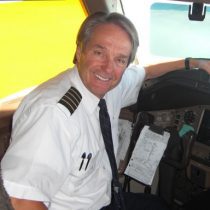
Nine months after being arrested, I strapped into a 747 at San Francisco International Airport and flew 400 people to Kona, Hawaii. Climbing through 10,000 feet, I looked back at the northern coast of California disappearing behind the wing. I was behind the yoke again. The check pilot that was with me did not know why I was re-qualifying, let alone why there were tears in my eyes.
I was warned about complacency, and my recovery did stall out after the first year. I had only completed three of the twelve steps. I was gambling and preoccupied with women. I had gained weight, was using smokeless tobacco, and drinking tons of caffeine. I was replacing the void I missed from cocaine and alcohol with other substances and self-defeating behaviors.
I couldn’t figure out why none of the newcomers had asked me to sponsor them. Then, my sponsor pointed out that; “Maybe I didn’t have anything that others wanted.” I was attending 12-step meetings, but was not really engaged in the program. I was taking everyone’s inventory except my own.
After another brush with the law, it became apparent that I had slipped into my old self-sabotaging behaviors. My lack of commitment and effort to my recovery had put me in relapse mode. I didn’t drink or use but I was heading in that direction. Once again, agony and discomfort were the motivators for change.
I learned from that experience that I could not help other men if they did not possess the ability to become honest, open minded and willing. I learned more about myself by listening and sponsoring other men. My human desire to please my sponsor restricted my learning potential while working the steps with him. By working with others, I became aware that each step of the 12-step recovery process contains a specific spiritual message and that the goal of the 12-Steps is to achieve a spiritual awakening. In late 2004, I was released from the FAA mandated monitoring. I vowed that I would not cut back on my recovery program. My love of sobriety and recovery actually grew stronger.
While on the staff as a counselor at Cornerstone, another vision became reality. I now facilitated groups in the same garage I had sat in five years earlier as a client, and had envisioned myself doing what my case manager, John, was doing. I loved looking the clients in the eye and telling them figuratively and literally, “I was in your seat.”
As I started to understand how much the brain was involved in addiction and recovery, I became aware that knowledge of this could help relieve the shame associated with addiction. Knowledge is power for the powerless. The neuroscience of addiction reinforces that recovery requires major reprogramming the brain’s neural circuits. This happens when total abstinence for mind altering chemicals, allows the brain to heal and re-regulate the electrical-chemical activity. On April 7, 2011, my wife Lori and I opened Get Real Recovery Inc in San Juan Capistrano, CA. We provide an Intensive Outpatient Program (IOP) and meaningful aftercare in small focused groups.
On January 14, 2016, I made my last landing at LAX. It was not my best touchdown, since it seems that my brain retired while we were about 50 feet in the air. I left the airline as I left the military, with no fanfare, just a smile and a wave good-by.
The less I want, the more content I am. I have changed how I pray and what I pray for, while striving to consciously improve my connection with God. Instead of petitioning God with a list of my wants, I ask only an understanding of God’s will and power to carry it out. I am absolutely certain God’s will for me is that I abstain from mind-altering chemicals. I am confident that the path I am on, as a teacher of recovery, is exactly what I am supposed to be doing in my time left in this world. I have found that being calm and quiet is the only way God and the universe can tell me what they want.